Not many people in North India, Cambodia and Laos know where Poland is. In Laos they asked me where are you from?
-"Poland"
-"France"
-"No, I am from Poland"
-"Yes, France"
-"Oki, I can be from France" (Laos was French colony).
In other countries they thought that I am from Holland (they are much better in Soccer than Polish team). Situation was a bit different in Thailand and Indonesia, where they knew Poland.
Showing posts with label India. Show all posts
Showing posts with label India. Show all posts
Thursday, March 10, 2011

Best never taken photos in Asia.
During this travel I usually carry my photo camera with me but sometimes I did not manage or I was not able or I thought it is inappropriate or I was not allowed to take photos. So here is a list of the most photogenic moments that are saved only in my mind:
Being tall in Asia.
 |
| In the bus in Bangkok. |
It is very often that I had to bend my back and be very carefully while waking on the street or entering any kind of doors not to hit with my forehead. The most scary was one local restaurant in India were the big vets were on the height of my eyes!!!
Fooooooood in Asia.
This will be a special entry where I will sum up experiencing heaven in my mouth in Asia....
Wednesday, October 20, 2010
My Incredible India
I spent in India two and a half months (I could not stay longer because of short visa) but now there are more places in India that I would like to see than before my travel. I have a feeling that I only had a small bit from this oriental tasty cake. I started my trip from spending few days in Kashmir. This region is very difficult to travel. Many Kashmir people are dreaming about their own independent country. The day that we left Kashmir serious riots started and are continuing all the time.
The longest time I spent in Ladakh, breathtaking Himalaya region, and still I hope to go back there one day since there are few things that I did not see and few others that I would love to see again. From there I went east (Rishikesh, Agra, Varanasi) but I omitted the colorful Rajasthan, which for sure I would love to see. Finally I stayed in Green Part of Himalaya, in Sikkim, where I redefine the definition of green and got completely soaked.
The longest time I spent in Ladakh, breathtaking Himalaya region, and still I hope to go back there one day since there are few things that I did not see and few others that I would love to see again. From there I went east (Rishikesh, Agra, Varanasi) but I omitted the colorful Rajasthan, which for sure I would love to see. Finally I stayed in Green Part of Himalaya, in Sikkim, where I redefine the definition of green and got completely soaked.
Thursday, October 14, 2010
Party Kolkata
I was not looking forward to staying four days in the big Indian city. I have already stayed 3 days in Delhi... and it was 3 days too long there. I was told that Kolkata is poorer than Delhi, so I was not expecting to enjoy it at all.
Luckily in Ladakh I met Kamil who was motorbiking around, and he was doing long term internship in Kolkata. He invited me to stay at his place if I would be in Kolkata. He lives in AIESEC student shared flat with people from all over the world who come to Kolkata for the short time internship. Those students spend most of their free time parting together. I spent in Kolkata four nights and three nights were for sure the most party evening in India for me. Kamil, thanks for hosting me.
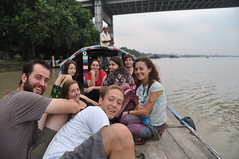
Luckily in Ladakh I met Kamil who was motorbiking around, and he was doing long term internship in Kolkata. He invited me to stay at his place if I would be in Kolkata. He lives in AIESEC student shared flat with people from all over the world who come to Kolkata for the short time internship. Those students spend most of their free time parting together. I spent in Kolkata four nights and three nights were for sure the most party evening in India for me. Kamil, thanks for hosting me.
Searching for Rhinos.
I have heard that India is also great place to see animals in it's natural environment. I decided to try to spot some rhinos in the Jaldhapara Wildlife Sanctuary. It is a National Park which is very rarely visited by western tourist in the North-East part of West Bengal. Without previous arrangement I reached the neighboring city to the park and figured out that it is not easy to get inside the park. One can enter it only for 2h long Jeep Safari or which gives much greater chances to see Rhino - for 1h long elephant Safari. Theoretically there was only one place inside the park where one could stay overnight but was very small (only 6 rooms) and is usually booked by Indian tourists months in advance. Luckily another western tourist show up - Judy, an Australian women, who is backpacking and hitchhiking all over the world for 30 years already. Now she retired, but she said that she does not have too many places that she have not seen already... I wander if I will be able to say like this in 30 years.
After few hours waiting and some additional Rupee, finally it was possible that we would spend the night in the park in this only guest house. The house was placed really in the middle of jungle and on the side there was a forest opening to which wild animals are coming from time to time (sometimes they are putting a bit of salt on this opening). The house was separated from the opening only by a very small river, which is for sure not a problem to cross for charging rhino or elephant. Basically from the front of our house we could appreciate wild animals in the night and at the sun rise time.

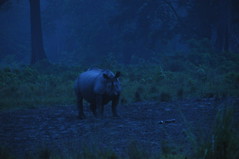
After few hours waiting and some additional Rupee, finally it was possible that we would spend the night in the park in this only guest house. The house was placed really in the middle of jungle and on the side there was a forest opening to which wild animals are coming from time to time (sometimes they are putting a bit of salt on this opening). The house was separated from the opening only by a very small river, which is for sure not a problem to cross for charging rhino or elephant. Basically from the front of our house we could appreciate wild animals in the night and at the sun rise time.
Sunday, October 3, 2010
Tea time
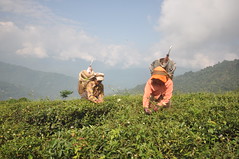
After Sikkim mountain experience I took a break in Darjeeling - the Indian capital of the finest tea. Early in the morning I walked down the hill through "The see of the tea plantation" observing how local women are picking up three youngest leaves from the tea plant. Apparently one of the reason for the excellent quality of the tea is the fact that females from this region have especially delicate hands. Of course no men is allowed to pick up the leaves.
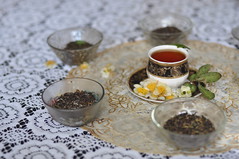
Afterward I walked back and in front of the local factory "Happy valley" I met a very lovely old lady who has a nickname "The 5 second lady" (she is lucky not to be five second guy). She invited me to taste the tea produced in a local factory "Super Fine Tippy Golden Flowery Orange Pekoe Number 1" and give me a short education about the quality of the local tea. Apparently this tea is the finest in Darjeellin. "Super Fine Tippy Golden Flowery Orange Pekoe Number 1" is a black tea that you have to brew only for 5 seconds, and you can reuse the same tea three times. I also tried the first quality green tea and yellow tea. And I have to admit that "Super Fine Tippy Golden Flowery Orange Pekoe Number 1" was very delicious.
Afterward I walked back and in front of the local factory "Happy valley" I met a very lovely old lady who has a nickname "The 5 second lady" (she is lucky not to be five second guy). She invited me to taste the tea produced in a local factory "Super Fine Tippy Golden Flowery Orange Pekoe Number 1" and give me a short education about the quality of the local tea. Apparently this tea is the finest in Darjeellin. "Super Fine Tippy Golden Flowery Orange Pekoe Number 1" is a black tea that you have to brew only for 5 seconds, and you can reuse the same tea three times. I also tried the first quality green tea and yellow tea. And I have to admit that "Super Fine Tippy Golden Flowery Orange Pekoe Number 1" was very delicious.
Friday, October 1, 2010
Which way? To and from Holy Lake.
I really enjoy traveling with my traveling mates, but I sometimes it is great to hike on your own. I decided to go to Kechopari Lake, which is holly lake. The road distance between Pelling and Kechopari Lake is 27 kilometers and I wanted to hitchhike in one direction and trek in the other. There were also some significant trekking shortcuts but there was a problem to find them.... In Sikkim it is impossible to buy any kind of the trekking map, non of the route is marked. So the only possibility is to constantly ask local people that one meet on the way, hopefully next to the crossroad. The problem is that local people here... seems not to hike so much like the local people in Ladakh, so sometimes they do not know the trekking shortcuts, and they do not have any clue what is the distance.
I wake up early in the morning and before 7 o'clock I was on my way. I planed to get any kind of the lift to the lake but unfortunately in the morning all cars (meaning 10 in total) were going in the opposite direction and I was told that there will be vehicles going to Kechopari Lake but in the afternoon. Finally, I manage to reach my destination in 5h getting two short lifts for 5km and finding few of the mysterious shortcuts.
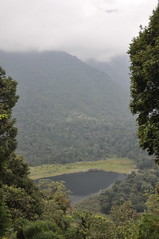
I wake up early in the morning and before 7 o'clock I was on my way. I planed to get any kind of the lift to the lake but unfortunately in the morning all cars (meaning 10 in total) were going in the opposite direction and I was told that there will be vehicles going to Kechopari Lake but in the afternoon. Finally, I manage to reach my destination in 5h getting two short lifts for 5km and finding few of the mysterious shortcuts.
Green Monastries
I wanted to see few monasteries in Sikkim to compare with the monasteries that I had came across in Ladakh. When I finished my first trek I met another Dutch person - Bas and a Tibetan girl - Pam and we decided to spend four days trekking together. For me Sikkim is kind of small Netherlands since... by chance I came across 6 dutch people and with 3 of them I went hiking.
Bas managed to travel to India from Netherlands mostly by hitchhiking on a very low budget, and Pam escaped from Tibet 10 years ago and now she misses her homeland a lot not having a possibility to go back.
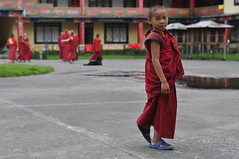
We managed to hike together to Dubdi, Tashiding, Ralang, Rabongla and Pelling Monastry.
We slept predominately next to monasteries.
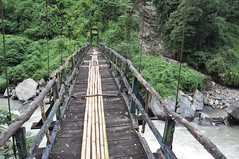
Once we did not manage to reach our destination before the sun set so when it was getting dark we looked for the home stay in the small village in the jungle on the way. We had hard time to communicate with the locals since the locals could speak only Nepali, but finally we manage to find a Bhutias family that spoke a bit of English and Tibetan and they offered us a very good meal and a place to sleep. That day the hike was very challenging. We had to walk down to the bridge on a very steep and slippery road. I slipped quite a few times there, and once... my rainbow umbrella that I was using as a walking stick, broke down. This same time Himalaya claimed my nail that I injured on the Toll Bridge (see the Under the bridge story). The new nail was growing all the time under the injured one and more than a half of nail is back already :)
Bas managed to travel to India from Netherlands mostly by hitchhiking on a very low budget, and Pam escaped from Tibet 10 years ago and now she misses her homeland a lot not having a possibility to go back.
We managed to hike together to Dubdi, Tashiding, Ralang, Rabongla and Pelling Monastry.
We slept predominately next to monasteries.
Once we did not manage to reach our destination before the sun set so when it was getting dark we looked for the home stay in the small village in the jungle on the way. We had hard time to communicate with the locals since the locals could speak only Nepali, but finally we manage to find a Bhutias family that spoke a bit of English and Tibetan and they offered us a very good meal and a place to sleep. That day the hike was very challenging. We had to walk down to the bridge on a very steep and slippery road. I slipped quite a few times there, and once... my rainbow umbrella that I was using as a walking stick, broke down. This same time Himalaya claimed my nail that I injured on the Toll Bridge (see the Under the bridge story). The new nail was growing all the time under the injured one and more than a half of nail is back already :)
Friday, September 24, 2010
Green, Greener, Sikkim
As well as wet, wetter, Sikkim.
Last few days I was experiencing Sikkim, really tiny part of India's Himalayas squeezed between Nepal and Bhutan. Almost 80% of population here are Nepalis that were brought by British in 19th century, the minority of the population are the Bhutias (come from Tibet in 14th century) and Lepchas (come first, probably from Far East). According to my local guidebook, official languages of the province are: Nepali, English, Bhutia, Lepcha, Limboo, Magar, Rai, Gurung, Sherpa, Tamang, Newari, Sunuwar. I wonder if there is any one that knows all official languages of this small province... Unfortunately only part of the Sikkim is open for tourist, it is very difficult or even impossible to explore North of Sikkim.
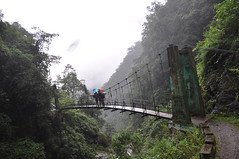
For the first four day trek I joined Wiet and Koen. We wanted to explore 'tourist' restricted areas, so we needed to organize a local guide. The day before we started I decided to buy my first ever umbrella. My first choice was not very good... umbrella got completely ruined after first opening. So I went for my second possibility - rainbow umbrella. And this time it was an excellent choice. The first day of our trek we experienced rain for most of the time. For 6-7h we were hiking almost constantly in rain. Initially I wanted to wear my rain jacket, but it was so warm, and so humid that I was getting wetter more from the sweat than from the rain.... so for whole day I was hiking with rainbow umbrella trying to convince sun to come out. The biggest problem I had with my hiking shoes that got leaking and were "drinking water" like crazy. At the end of the day my shoes triple their weight!!! Despite of the rain, for the whole time of our trek the dog Rodos, which was very similar to my parents dogs, was accompany us. We hiked through a jungle, crossed four big rivers and many small and big waterfalls.
Last few days I was experiencing Sikkim, really tiny part of India's Himalayas squeezed between Nepal and Bhutan. Almost 80% of population here are Nepalis that were brought by British in 19th century, the minority of the population are the Bhutias (come from Tibet in 14th century) and Lepchas (come first, probably from Far East). According to my local guidebook, official languages of the province are: Nepali, English, Bhutia, Lepcha, Limboo, Magar, Rai, Gurung, Sherpa, Tamang, Newari, Sunuwar. I wonder if there is any one that knows all official languages of this small province... Unfortunately only part of the Sikkim is open for tourist, it is very difficult or even impossible to explore North of Sikkim.
For the first four day trek I joined Wiet and Koen. We wanted to explore 'tourist' restricted areas, so we needed to organize a local guide. The day before we started I decided to buy my first ever umbrella. My first choice was not very good... umbrella got completely ruined after first opening. So I went for my second possibility - rainbow umbrella. And this time it was an excellent choice. The first day of our trek we experienced rain for most of the time. For 6-7h we were hiking almost constantly in rain. Initially I wanted to wear my rain jacket, but it was so warm, and so humid that I was getting wetter more from the sweat than from the rain.... so for whole day I was hiking with rainbow umbrella trying to convince sun to come out. The biggest problem I had with my hiking shoes that got leaking and were "drinking water" like crazy. At the end of the day my shoes triple their weight!!! Despite of the rain, for the whole time of our trek the dog Rodos, which was very similar to my parents dogs, was accompany us. We hiked through a jungle, crossed four big rivers and many small and big waterfalls.
Taj Yoga
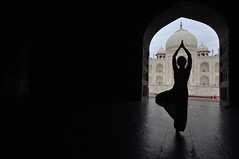
After few days travel I arrived to Rishikesh, which is claimed to be 'Capital of Yoga' ever since Beatles came here in '60s. Here I met Aneta, my old friend from university and she convinced me to try Yoga for the first time . I have to say I like it to certain extend and I hope I will try it more in future.
Wondering around Rishikesh we come across the ultra beautiful waterfall under which one could swim. The scenery was almost like from the paradise maybe except.... to refreshing temperature of the water. No photo of this scenery, since I did not have my camera with me that time.
Wondering around Rishikesh we come across the ultra beautiful waterfall under which one could swim. The scenery was almost like from the paradise maybe except.... to refreshing temperature of the water. No photo of this scenery, since I did not have my camera with me that time.
Monday, September 6, 2010
Surfing the Himalayas from Leh to Manali
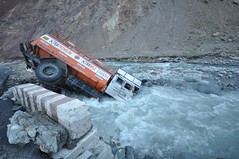
From Leh I wanted to go South to Manali. After the floods the road was open but it was much longer than the old road, since the floods destroyed 20 km of the old road. There was detour which make the road much longer and much more bumpy.
This would mean two days for 12h/a day in a "roller-coaster" bus (instead 16h by the old road). I almost decided to go by this bus but on the way to buy a ticket I met Maciek from Poland. We immediately agreed to try to hitchhike together to Manali, preferably on the big lorry - TATA next morning, which would be a bit slower than the bus, but would be more comfortable and I would have for sure more space for my long legs.
Next morning we met shortly after the sun rise and tried to go in the direction of Manali. Unfortunately none of the big trucks was going in this direction. I guess the the quality of the detour did not allow the big lorry to go this road. But nevertheless we decided to go and with 4 different cars: with Tibetan Monk, bus, with solders, on the lorry full of sand (which was like surfing in Himalayas),
we managed to get to Upshi to the place where the detour to Manali starts. Than we changed our plans and decided that it is much nicer to hike around the old, destroyed road to Manali than to drive so many additional hours in the bus. So from Upshi we departured in direction to Rumtse (around 31km). The road was very beautiful and for the first 5 km we were lucky to get a lift with the army truck which was bringing the food for the road workers. Well... they did not manage to get all the food, since quite a bit of dall, which was in a simple bowl end up at the floor and our shoes because the road was really bumpy. The work on the repair of the road was in
progress, and if in India someone says that there is no 20km of the road, this literally mean there is no 20km of the road. In our case in the place where there supposed to be a road there was a river. So the way involved quite a bit of climbing around the non-existing road, over the river. Luckily at the end of the day we manage to reach Rumtse.
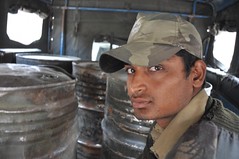
This would mean two days for 12h/a day in a "roller-coaster" bus (instead 16h by the old road). I almost decided to go by this bus but on the way to buy a ticket I met Maciek from Poland. We immediately agreed to try to hitchhike together to Manali, preferably on the big lorry - TATA next morning, which would be a bit slower than the bus, but would be more comfortable and I would have for sure more space for my long legs.
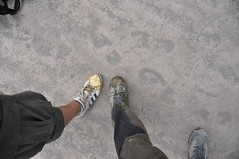
Next morning we met shortly after the sun rise and tried to go in the direction of Manali. Unfortunately none of the big trucks was going in this direction. I guess the the quality of the detour did not allow the big lorry to go this road. But nevertheless we decided to go and with 4 different cars: with Tibetan Monk, bus, with solders, on the lorry full of sand (which was like surfing in Himalayas),
we managed to get to Upshi to the place where the detour to Manali starts. Than we changed our plans and decided that it is much nicer to hike around the old, destroyed road to Manali than to drive so many additional hours in the bus. So from Upshi we departured in direction to Rumtse (around 31km). The road was very beautiful and for the first 5 km we were lucky to get a lift with the army truck which was bringing the food for the road workers. Well... they did not manage to get all the food, since quite a bit of dall, which was in a simple bowl end up at the floor and our shoes because the road was really bumpy. The work on the repair of the road was in
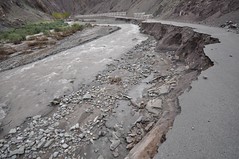
progress, and if in India someone says that there is no 20km of the road, this literally mean there is no 20km of the road. In our case in the place where there supposed to be a road there was a river. So the way involved quite a bit of climbing around the non-existing road, over the river. Luckily at the end of the day we manage to reach Rumtse.
Thursday, September 2, 2010
Julley, Julley, Julley
After quite a few weeks I am finally leaving Ladakh. Julley is the key word in Ladakhi language, which serves the most of the purpose word for hello, goodbye, and thank you. So Julley Ladakh, but especially Julley to all Ladakhi and Tibetan people that I come across on my way.
Tomorrow I will try to get to Manali by the Roller coaster - road, which can take 2 or 3 days.
Tomorrow I will try to get to Manali by the Roller coaster - road, which can take 2 or 3 days.
Smell of Tibet
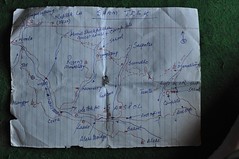
Around Leh I visited quite a few monasteries. For the last trip I received from the local guide a hand drawn and very detailed map of the most interesting monasteries West of Leh as well suggestion about the best home stay in every village. Every monastery was located in the distance of one day hike from each other.
The second night of the trek I stayed in Mangyue with the family that was taking care about the very monastery and they had keys to some additional monastery rooms which are usually not available for tourists.
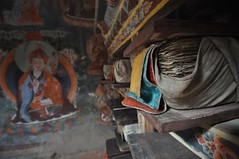
In one of the rooms I came across amazing collection of old books. This was the first time that I was exposed so closely too old books. I could smell their age, I could fell them with every of my senses. I really imagine that Tibet has to smell a bit similar. I hope I will manage to visit Tibet one day.
Sunday, August 29, 2010
Leh (3500m) to Khardung La (5359m) - bike race
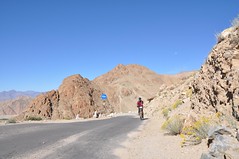
I am Polish, and last years I was living in Dresden. In both of those places the floods happened. More over all my knees doctors were saying that biking is the best sport for me. I guess those two reason convince me to participate in the FIRST ever bike race from Leh to the highest motorable pass - Khardung La. The way is 39 km and constantly is ascending for almost 2000m. The race was organize in order to help the flood victims.
So I decided to joined.
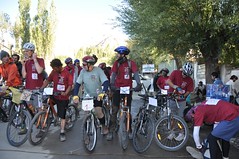
My own aim was to get to the pass on the bike, no matter how long this would take. The day before I manage to find big enough bike for me - which I named Khar (from the place that we were suppose to go together). It was not spectacular bike, but the lower gears worked properly, and it had working V-breaks. On Sunday 7-o'clock in the morning 32 participants gather (both locals and tourists). Apparently I was the only participant from Poland. There was quite a bit of media coverage of our race, there were three different film craws.
Before 8 o'clock we started. The first 20 km were surprisingly easy. I was going with my own speed and did not have to stop for the breathing breaks. There was not many cars on the road, but soon I realize that i do not really see anyone in front of me or behind me.
Every 10 km there were people standing and were providing some basic refreshment. It was really organize like a race!!! Than the tiredness kicked in a bit and after 25th km the quality of the road decreased, there was no more asphalt, but predominantly sand and stones, more over the road got a bit more steeper. But the most tiring were the last 10 km. The road got really bad, I was getting really tired and the concentration of the oxygen in the air dropped a lot. The closest to the end, the most often I had to make some breathing breaks. And finally there was the end, together with my Khar we manage to climb to Khardung La.
So I decided to joined.
My own aim was to get to the pass on the bike, no matter how long this would take. The day before I manage to find big enough bike for me - which I named Khar (from the place that we were suppose to go together). It was not spectacular bike, but the lower gears worked properly, and it had working V-breaks. On Sunday 7-o'clock in the morning 32 participants gather (both locals and tourists). Apparently I was the only participant from Poland. There was quite a bit of media coverage of our race, there were three different film craws.
Before 8 o'clock we started. The first 20 km were surprisingly easy. I was going with my own speed and did not have to stop for the breathing breaks. There was not many cars on the road, but soon I realize that i do not really see anyone in front of me or behind me.
Every 10 km there were people standing and were providing some basic refreshment. It was really organize like a race!!! Than the tiredness kicked in a bit and after 25th km the quality of the road decreased, there was no more asphalt, but predominantly sand and stones, more over the road got a bit more steeper. But the most tiring were the last 10 km. The road got really bad, I was getting really tired and the concentration of the oxygen in the air dropped a lot. The closest to the end, the most often I had to make some breathing breaks. And finally there was the end, together with my Khar we manage to climb to Khardung La.
Wednesday, August 25, 2010
Stok Kangri (elevation 6137m)
, For two days I was searching for people to join the amateur Stok Kangri expedition. And the second day indeed I managed to find in the internet cafe Marcin and Wojtek who were also considering to climb Stok Kangri. Together we gathered the necessary equipment (tent, food, water purification tablets, crampons, ice axes) and information. It was supposed to be an relatively easy summit, but due to heavy recent rain/snowfalls it could have been more challenging than usual.
We departure to the village Stok, we got the permit for this peak, and started to climb slowly to the base-camp. Most of the other tourist rent donkeys or horses, but we decided to be tough and to do it in Polish way and we carried all the gear in our rucksacks. We reached the base-camp (at 5000m) and we still decided to spend two more days for acclimatization. During this time I got the most sever diarrhea in India till now.
Half past midnight at 22nd of August (still with diarrhea) we decided that the weather was good enough to get to the summit and we started our trip.
We departure to the village Stok, we got the permit for this peak, and started to climb slowly to the base-camp. Most of the other tourist rent donkeys or horses, but we decided to be tough and to do it in Polish way and we carried all the gear in our rucksacks. We reached the base-camp (at 5000m) and we still decided to spend two more days for acclimatization. During this time I got the most sever diarrhea in India till now.
Half past midnight at 22nd of August (still with diarrhea) we decided that the weather was good enough to get to the summit and we started our trip.
Tuesday, August 17, 2010
Back to the mounties
The weather condition in Ladakh is much better now, so we decided to go back to the mountains. In guess I will be back in 5-7 days back in Leh.
Unfortunately my mobile decided to take different traveling route than I, so we kind of split. It is a bit of pity, but on the other hand there was no network coverage for my mobile network in North India.
Unfortunately my mobile decided to take different traveling route than I, so we kind of split. It is a bit of pity, but on the other hand there was no network coverage for my mobile network in North India.
Tuesday, August 10, 2010
Floods in Ladakh
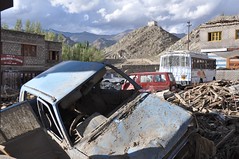
In the night of 5th-6th August heavy floods and mood avalanches hit Leh and neighborhood villages cousins the death of around 400 local people and several tourists. One part of the city was completely washed away.
That night there were very heavy rainfalls. It usually does not rain in this region, that night the monsoon manage to get over High Himalayas and withing one hour there was more rain.... than the half YEARLY rainfall in this region. The soil is not used to absorb those amounts of water, so there were massive land slides and mood-stone avalanches in the region. Whole province was disconnected from the world. The huge mood-stone avalanche destroyed the airport and nine bridges were broken off on the only two roads leading from the region (in direction of Kashmir and in direction of Manali). It took five days for army to clean up the airport and then most of the tourist flew away as fast as possible. It took around two weeks to repair the first road connection to Kashmir and the road to Manali is still not repaired.
That night there were very heavy rainfalls. It usually does not rain in this region, that night the monsoon manage to get over High Himalayas and withing one hour there was more rain.... than the half YEARLY rainfall in this region. The soil is not used to absorb those amounts of water, so there were massive land slides and mood-stone avalanches in the region. Whole province was disconnected from the world. The huge mood-stone avalanche destroyed the airport and nine bridges were broken off on the only two roads leading from the region (in direction of Kashmir and in direction of Manali). It took five days for army to clean up the airport and then most of the tourist flew away as fast as possible. It took around two weeks to repair the first road connection to Kashmir and the road to Manali is still not repaired.
Saturday, August 7, 2010
Under the bridge
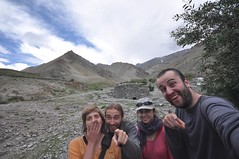
For our trek in Ladakh we have chosen to go to Markha Valley. We were four (me, Wojtek, Olga and Asia) and decided to rent a tent for three people which was big enough for four people and was also very light. It was a low quality tent, but the price was also very low and in Ladakh it never rains, so it should have been fine. We also organized some food.
Unfortunately after the first one and a half day of trek Asia got sick (stomach problems) and we decided to split for few next days. Wojtek and Asia chosen to do shorter track with home-stays on the way, and me and Olga wanted to complete Markha Valley trek for which we needed the tent.
The second night of the trek, on the 4000 meters altitude.... it started to rain and of course our tent started to leak. We managed to survive it till the sunrise without getting our feather sleeping bags wet.
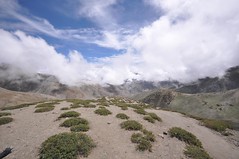
In the morning we departure for our first ever high pass GandaLa (4950 meters). The weather cleared out. The last 500 meters before the pass were very difficult. I needed many breathing breaks on the way, but we reached it and enjoyed beautiful views. Then we went down through beautiful valley crossing one river at least twelve times. We reached Skiu for the night, set up our tent hoping that it would not rain that night. Unfortunately that night it was raining even more than the last one.
In the morning we started walking

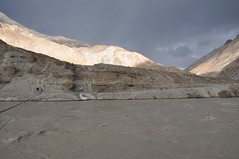
to Markha but on the way few people discouraged us from this idea. There was a need to cross the Markha river without the bridge, but the level of the water raised so much that it was currently impossible. We did not wanted to wait for unknown number of days for the water level to drop, so we retracted and we decided to go back other way to Chiling. On the way to Chiling we needed to cross much bigger river - Zanskar river, but there was a toll bridge there. I did not really now before what is a toll bridge.
Basically there is a metal rope connecting two sides of the river and below there is a small wooden basket in which one have to go. In order to get to the other side you have to pull the rope, or alternatively the rope is pulled by someone on the other side of the river. Sounds easy... but it is not so easy, at least not in the windy and a bit stormy conditions that we experienced. We were on the side of the river where there was no one. After few minutes of waiting and waiving we were spotted and two men released the wooden basket from the other side. I helped Olga to get to the basket together with her rucksack and she safely arrived to the other side. Now it was my turn.
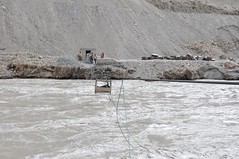
The wind was getting stronger and I had to get to the basket. There was no one to help me on this side of the river, I was holding basket with one hand and the metal wire with the other, but I did not know how to jump to this basket without risking falling to the river. It took me quite a few extremely long minutes to find out a way, and finally I managed to get inside getting only one small injury to my fingernail (i did not manage to remove my hand on time from the metal wire). But I was safely in the basket which was going on to the other side, and suddenly it STOPPED!!!
Subscribe to:
Posts (Atom)